

Emergency Medical Technician
As a paramedic, you are the professional responder at the scene of an accident. You must quickly assess the situation, make decisions, and administer medical care. In addition, you ensure that vehicles and equipment are ready for deployment. Another area of responsibility is handling emergency calls at the central dispatch center. The three-year training program is conducted in accordance with the Emergency Medical Technician Act.
The training begins on September 1 of each year and lasts for three years. It is conducted through a dual training system.
Applications are accepted annually from September 1 through November 30 for the upcoming training year.
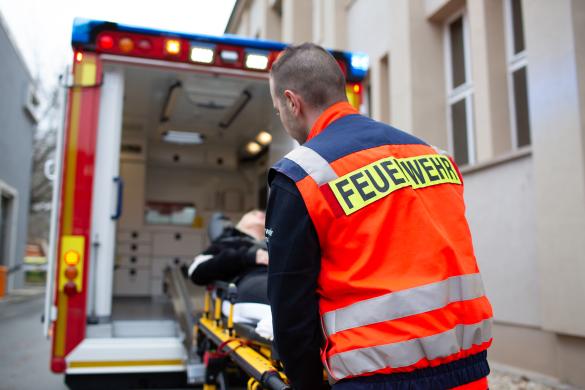
Notfallsanitäter im Einsatz
© Stadt Jena/Tobias Stepper
Requirements
- At least a Realschulabschluss or a vocational training program of at least two years’ duration successfully completed after earning a Hauptschulabschluss
- Medical fitness for service in emergency medical services and the professional fire department (medical examination will be conducted by the City of Jena following the selection decision)
- Possession of a Class B driver’s license (must be obtained no later than during the training program)
- Interest in medical aspects of emergency medicine, as well as a passion for and aptitude in working with technology
- A sense of responsibility, empathy, flexibility, and the ability to work well in a team
- Business-level proficiency in German, at least C1 language level
The following are considered an advantage
- Experience volunteering with a volunteer fire department or another aid organization, such as the German Red Cross (DRK), ASB, Malteser Hilfsdienst, DLRG, or similar
- An internship in the medical or nursing field
- Class C driver’s license
Theory
Theoretical knowledge is taught by the DRK-Bildungswerk Thüringen gGmbH in Meiningen
Key areas of focus in the training include, among others:
- Recognizing, assessing, and evaluating emergency and hazardous situations,
- Selecting, implementing, and evaluating emergency medical and hazard mitigation measures,
- Communicating and interacting with people seeking help and those in need of assistance,
- Structuring emergency medical service procedures, and
- Assisting with medical diagnosis and treatment.
Practice
During your practical training, you will be assigned to emergency stations in the city of Jena, as well as in the surrounding area and at hospitals. You will learn:
- how to perform emergency medical procedures at the scene of an accident,
- how to assist emergency physicians,
- maintaining, restocking, and disinfecting vehicles and medical equipment,
- how to document calls and write reports,
- handling emergency calls and dispatching emergency resources from the central control centers,
- and much more.
Perspectives
We offer you:
- A high-quality and varied apprenticeship with good chances of being hired after completion.
- Excellent opportunities for continuing education with comprehensive support from your employer.
Upon successful completion of your training as a paramedic, if you are deemed suitable for a career in the mid-level fire service, you will undergo subsequent training as a fire captain candidate in a civil service position subject to revocation.